
Is It Live?
… Audiences and Interplay in Rap Records

The notion of live rap songs pressed onto vinyl has always been of interest to me. There are the obvious examples such as Bee-Bop’s Live Convention ‘81 and ‘82, Bambaataa’s Death Mix—Live!!!, and Run-D.MC.’s ‘Here We Go (Live at The Funhouse)’ which, when listened to parallel with the deep bass cut song ‘Together Forever (Krush-Groove 4) (Live At Hollis Park ‘84)’, acts as the segue into the argument that is the focus of this article: the mimicking and recreation of live hip hop in the studio environment. Of course, the most impactful of this typology must be the call-and-response voices in ‘Planet Rock’.
These records of the 1980s are not a quaint historical curiosity; they are one of the pivotal battlegrounds through which hip hop was forcibly translated from a community-based performance practice into a commodified, industrial product. These records—whether genuinely taped in clubs or meticulously constructed in small studios—dramatize a cultural struggle between embodied presence and commercial representation. They contributed heavily to shaping hip hop’s material survival: the transformation of a living, communal event into an object manufactured for sale, circulation and profit.
The abundance of ‘live’ rhetoric and sonic tropes in early hip hop must be understood not simply as mimicry but as a defensive manoeuvre. Hip hop’s pioneers were confronted with a recording industry that could capture neither the cultural density nor the political complexity of the live jam. The studio, with its sanitising logics of isolation, segmentation and overdub, posed a threat to the very ontology of the culture, and many of the genre’s early recordings try to fill this representational void and relate to audiences through a fabrication of ‘liveness’. These ‘live’ attributes are not just aesthetic choices; they behave as a protest against the inadequacy of the medium, an insistence that the record carry, however artificially, the traces of the practice from which it emerged.
I would argue that this is why the early ‘live’ records often feel excessive. They refuse to let the listener forget that hip hop was born in public space: the basketball courts, the parks, the rec centres, the block. They weaponise the sounds of collectivity—cheers, chants, crowd surges—against the isolating tendencies of the recording industry. By inscribing the communal on the commodity becomes an act of resistance, even if executed through the very tools that commercialise the culture.
But the politics of these reenactments are double-edged. The simulated live moment is also a site of capture. In the hands of labels, promoters and radio programmers, ‘live’ becomes packaging: a marketable aura rather than an authentic event. While artists tried to preserve the adrenaline of the jam, the industry seized the opportunity to freeze, flatten and monetise it. The faux-live record is at risk of becoming a fetish object—a domesticated version of the real thing sold back to listeners by proxy. The pressing plant stands in for the block party; vinyl replaces gathering. The result is a cultural substitution disguised as documentation. But, there is a further possibility, one where the artists know all the above but continue to make the songs to realign the core values of hip hop within the frame of product consumption.
If these records are studied, an interrogation of the politics of representation can be undertaken: what does it mean to turn ‘liveness’ into a reproducible effect? What is lost when the messy, improvisational, communal energies of a party are diced into sample loops and staged applause? And what is gained when artists strategically manipulate the medium to smuggle traces of that energy into the grooves?
The answers can only be dialectical. The ‘live’ record is both an act of survival and an act of hijacking. It preserves the memory of the culture as it simultaneously that culture to the logics of industrial production. The studio becomes a prosthetic performance space, a site where the affective charge of hip hop is artificially reconstructed even as the social world that gave rise to it is evacuated, but this is often intentionally built by the artists themselves. Listeners are invited into a fantasy of participation; they are asked to imagine themselves in a crowd that, except on the rawest live tapes, never existed. And that, is the beauty of hip hop’s ability to continually reinvent itself, with granular detail and great subtlety that carry a hidden impact.
The disappearance of these tropes in the 1990s is not accidental. By then, the recording—the album, and in particular, the CD and even the video single—had become the dominant representational forms of hip hop music. The live event no longer seemed to hold epistemological primacy. The battle was over, and the studio had won. Hip hop’s ontology shifted: from live ritual to manufactured object, from embodied communal intensity to individually consumed commodity.
In this sense, the ‘live’ records of the 1980s are monuments to a contested transition. They are sonic battlegrounds where artists wrestled with the violence of translation, negotiating the forced migration of hip hop from social event to recorded product. When we listen to these records, we hear artists refusing to let the medium erase the culture’s foundations: insisting, sometimes desperately, that the record remain tethered to the jam, that the crowd, however synthetic, remain audible in the grooves.
The ‘live’ illusion is thus not an aesthetic quirk; it is an audible struggle over cultural authority. Who gets to define hip hop? The community that creates it, or the industry that packages it? The answer reverberates through these records, through every reverb-laden cheer, every staged interruption, every artificially heightened call-and-response.
These records document a culture fighting to stay alive inside a medium that was never built to contain it. They stand as reminders that hip hop’s earliest encounters with the recording industry were not smooth incorporations but antagonistic collisions—collisions whose aftershocks continue to shape the culture today, and many also included the word ‘live’ in the title as a further act of persuasion. Below, I have listed and commented on nine exemplars which each address the idea of ‘live’ uniquely, but rather than an either/or, live versus studio, I invite you to read these records as hybrid artefacts for which the ability to simulate immediacy is itself a form of cultural success. The simulated live moment is a prosthetic presence; it is an audible attempt at conjuration that simultaneously anchors hip hop to its origins of the event and detaches it into the reproducible commodity. Far from a mere historical curiosity, the era’s ‘live’ records are instructional: they teach us about the stakes of translating performative practices into media, and they reveal how early hip hop negotiated its move from ephemeral ritual to permanent object.
1. ‘Rock the Bells’ — L.L. Cool J
Though often heard as a studio single, the track’s vocal performance adopts the rhetorical textures of a staged set. The production foregrounds dynamic contrast—vernacular hollers punctuating measured verses and a highly treble-focused concoction of percussion—that reads as responsive, as if a crowd’s approval were cutting in and out of the mix. The ‘crowd’ in ‘Rock the Bells’ is not an audience but a weapon, a phantom collective conjured to validate L.L.’s dominance, particularly in the dialogue: “Why are girlies on the tip?”, “L.L.’s your name!” No individual is heard, yet every shouted ad-lib functions as an acoustic placeholder for mass approval. L.L. performs as if commanding thousands; the crowd here is a political fiction, a community invoked to grant authority to the lone emcee, where its absence is the point.
2. ‘The Show’ — Doug E. Fresh & the Get Fresh Crew
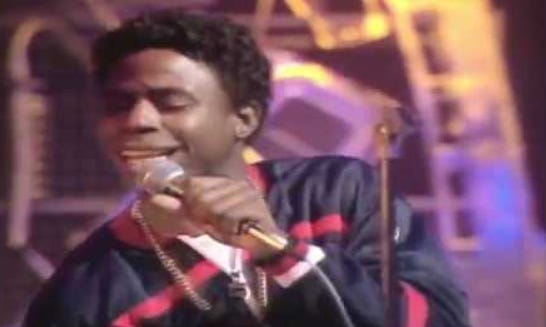
This record foregrounds beat boxing’s live index. Vocal percussion is mixed for immediacy, left slightly forward in the sound-stage, and peppered with on-mic asides, laughter and patter that reenact the intimacy of a small club. Crowd elements are explicit at the beginning of the record with echoes of “Doug E., Doug E.!” heard chanting before Doug E. Fresh & the Get Fresh Crew are introduced as part of “… the most exciting stage show you’ve ever witnessed …”, followed by Chill Will and Barry B’s cutting up of ‘Oh my God!” alongside Doug’s beatbox. Yet, still the crowd continue, distant but dense: this is crowd as intimacy: a miniature, imagined audience embedded inside the banter. Beatboxing becomes the sonic evidence of liveness, and together with jokes, stories and differing rhyme patterns, the record constructs community by shrinking it, simulating not a stadium roar but a tightly packed space where bodies lean in to witness craft, despite the sounds of a seemingly huge crowd.
3. ‘The Circus (Let’s Get Stupid)’ — Divine Sounds
The circus metaphor becomes literal in the sonic architecture of this song. In Electro Rap: Science Fiction, Fantasy and Reality in the Circuitry of Hip Hop, I explored ‘The Circus’ with respect to its fantastical notions:
Divine Sounds’ ‘The Circus (Let’s Get Stupid)’ frames what could be a typical braggadocio rap within the division of the circus; a kid desperately pleads with his mother to see the show in a soundbite narrative presented over an uncanny interpolation of Fučík’s ‘Entrance of the Gladiators’ (1897) played on an organ. The audience imagines Mike Music, Disco Ritchie and Shelton D as circus performers as they deliver an unconventional series of verse, primarily due to the introduction of chants relating to the trope ‘get stupid’, but particularly “Go Rambo!” which repeats eight times (de Paor-Evans 2026: 126-7).
Here the crowd is a theatrical device, a staged roar deployed like scenery. However, the curiosity of the absurd creeps into this song through the representations of the crowd. During the passage; “Well let me hear ya say ho … say ho ho … say ho, ho, ho … get ready, get set, and go for what you know”, the crowd do not respond as expected. Instead, the interpolation of ‘Entrance of the Gladiators’ continues over which is slung a generic, distant, sound effect of a large crowd cheering continually, as if on a loop. This provides a strange but speculative space, one where the audience sonics become an aesthetic resource seemingly manipulated to offer an intentionally artificial sound.
4. ‘Ultimate III (Live)’ — Ultimate III
This track uses layered reverb, shouted call-backs and punchy percussion to simulate a large concert. The notion of ‘live’ here is a dramaturgy of intensity rather than scale: the record manufactures uncanny sense of intimacy—the sense that the emcees are inches from the listener but concurrently far away in a huge auditorium, plays with the idea of live hip hop and its occupation of the arena, almost signposting Run-D.M.C.’s appearance at Live Aid. What adds to this narrative is the opening sequence. Listeners hear a door swing—presumably a dressing room door backstage—followed by: “Ultimate III, time to go on,” called by the promoter or stage manager. Ultimate II respond—to each other (we can assume the promoter has departed at this point)—with: “Let’s rock this party, y’all”, “Word up!” “Yo, let’s do (U)ultimate damage.” Further interesting, is overlaid atop the crowd cheering, is a sonic signifier—a sample-chant—but the listener cannot determine if it is the crowd urging them on stage, or an invisible sonic montage hype cyborg: “Ultimate Ultimate! Ul- Ul- Ul- Ultimate Ultimate!” In this way, the representations on record resonate with the abstractions of ‘The Circus’.
5. ‘Pump That Bass / Live (Get A Little Stupid... Ho!)’ — Original Concept
A playful, almost vaudevillian mimicry of onstage hi-jinks anchors this magnificent track. The switch ups in percussion, spin-backs and silky cuts are plentiful throughout, but an overt song analysis is not the focus here. The call-and-response motifs are clearest here than in any song in this article; the title explains much. IN and among the continual party vibe “(W)Ho!” chanting, the rhetoric questions of Original Concept are, indeed, original in concept: “What you gonna do when you buy this record?” “What you gonna do when you play this jam?” “What you gonna do when it’s in your car?” And the respective answers from the crowd are equally as dope: “Pump that bass!”, “Turn it up!”, and again, “Pump that bass!” This part especially operates both intense and condensed, framing and consolidating the idea of the live jam. Overall, this song is a powerhouse of what it means to be live in three minutes and six seconds, all with no structured verse of rap.
6. ‘Def Fresh Crew’ — Roxanne Shanté (with Biz Markie, uncredited)
This cut delivered enormous originality but and brought with it a sense of puzzlement to listeners. Upon seeing the product, the Pop Art Records label with its infamous burgundy and grey colouring and pop-graff lettering had become synonymous (largely thanks to Marley Marl) with quality hip hop music. Coupled with Roxanne Shanté’s name on the label, listeners (me included) braced themselves for another banger i the vein of ‘Queen of Rox’ (Shanté rox on), ‘Runaway’, or the sterling ‘Bite This’. Yet, what was received was a faux-live show in the form of Biz Markie beatboxing the entire music and Shanté doing what she does best—delivering sizzling freestyle raps. The presence of an uncredited voice encourages readings of staged surprise—as if the studio captured an unplanned cameo, despite Shanté continually name-checking Biz in her lyrics. The ‘live’ effect is accomplished through muffled crowd and Marley Marl’s insightful production techniques (here his experience as an engineer shines), to capture both voices as if a live recording. Hence, the record simulates a dynamic social field in which the power between the recorded artefact and the live show is contested and adjudicated in a false sense of real time: the people, whether real or not, are always on Shanté’s side.
7. ‘Beat Box is Rocking’ — Fat Boys
Utilizing the metaphor of the live boxing match, Beatboxing as spectacle is central: vocal percussion is highlighted and amplified, producing a tactile, bodily immediacy. Kool Rock Ski opens as Master of Ceremony with: “Ladies and gentlemen, introducing, in the red corner …” over shouts, hollers, whistles and cheers. This song is incredibly fast-paced, and among the relentless and repetitive beatbox patterns of The Ox That Rocks, sampled hollers of “That’s good …” “He’s the real beat box, may man,” and “Stupid Def!” deliver a highly processed song that foregrounds the digital age with great originality. Yet, it is the opening and especially the insane 6 seconds sequence between 1.20 and 1.26 that shout ‘live’. Here, the (sparse) crowd is essentially a foil for beatbox virtuosity: its shouts and cheers prove the body’s supremacy over machinery. But the audience here is an acoustic hologram, inserted to turn bodily percussion into public spectacle. The Ox performs not for a present crowd but for a constructed one, intentionally blurring where the live human ends and the studio imaginary begins. The live effect hinges on a fantasy, that virtuosity automatically creates community.
8. ‘Fastest Man Alive’ — Grandmaster Flash
‘Fastest Man Alive’ conceptually similar to both ‘Beat Box is Rocking’ and ‘The Circus’, as, indeed, is its ideation. By this, I mean as Fat Boys use the boxing match metaphor and Divine Sounds the sideshow, so too do Grandmaster Flash to set the scene. The song begins with a circus organ trope, and the calls:
Step right up, Hurry, hurry, Hurry
Ladies and Gentlemen, Boys and Girls
Children of all ages
Move closer and bear witness to the one who cuts on
Not one, not two, but three turntables
Known throughout the four corners of the world as
The Fastest Man Alive (‘Fastest Man Alive’, Grandmaster Flash 1986).
This piece stages competitive virtuosity through this simulation: the sideshow/circus-esque result is a dramatized flex of skills: speed and dexterity become theatrical properties, and the studio microphones capture and amplify these gestures to produce the illusion of a public adjudication.
9. ‘Ugly People Be Quiet’ — Cash Money & Marvelous
This track is potentially the most electrifying of all the songs mentioned in this article in terms of crowd representations. Swirling under the tumbling piano chords of ‘Head Over Heels’ by Tears For Fears, the sound of a stadium-scale crowd is heard. This is both exacerbated and amplified by the continual sample of Mountain’s ‘Long Red’; the liveness takes on an intertextual quality as the sample is lifted from Mountain Live: The Road Goes Ever On (1972), meaning the crowd heard in ‘Ugly People Be Quiet’ is additionally the crowd from the Mountain album.
This ‘double-crowd’ representation is weaponized as a true hip hop practice; the fabrication affirms the sensibilities of hip hop break beats and affirms Cash and Marv’s authority. The ‘live’ aura is transposed as acoustic fiction, used to enforce the sonic and performative multiplicity of hip hop practice.
The intention of this article has been to highlight the various methods and processes used in rap music practice during the mid-1980s to reify, preserve, and progress the importance of what it means to be ‘live’ on rap records. Additionally, each song discussed above remain a testament to this period of uncertainty, instability and shift that hip hop music experienced in its shift from a local-regional practice to a global commodity. Moreover, the idea that first and foremost rap is a live practice is central to all these songs, and true to its roots, hip hop retained its sense of originality, as indeed, the songs above illustrate.
Orders for The Dark Nineties: Falling Out of Love with Hip Hop (the third and final book in the Headz Trilogy) are still shipping - with 37 copies left at the time of this article!
The book contains 21 stories, extensive endnotes, and 200+ pages ... written with a more abstract and autotheoretic approach than Scratching the Surface and Hip Hop in The Sticks, the text The Dark Nineties closes the loop on 18 years of hip hop autofiction.
Substack subscribers can enjoy a 10% discount if purchased direct from Rhythm Obscura. To order, PayPal £14.40 (UK), £19.70 (EU, and contact me for ROW prices) as FRIENDS AND FAMILY/GIFT to: theprojectcee@gmail.com
Thank you to all of you that have already ordered!
This is brilliant work on the politics of liveness in early hip hop. The idea that these tracks were defensive maneuvers, not just nostalgia, really shifts how I hear something like 'Rock the Bells' now. I dunno if the artists fully understood they were creating 'acoustic holograms,' but they definately knew the studio threatened somthing essential about the culture.